

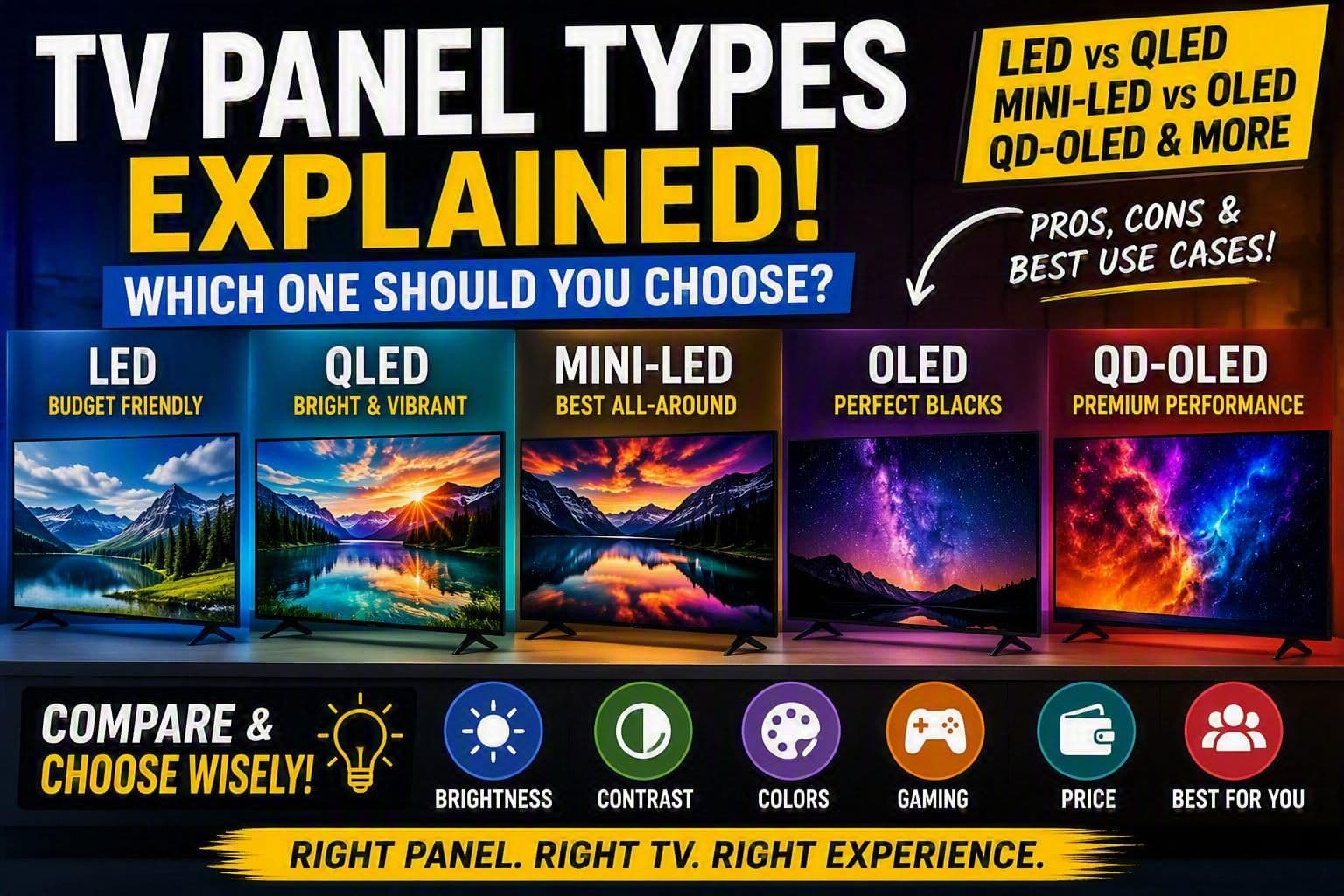
TV Panel Types Explained: Which TV Display Technology Is Right for You?
If you've started shopping for a new TV, you've probably come across terms like LED, QLED, Mini-LED, OLED, and QD-OLED. Manufacturers often promote these technologies as game-changing innovations, but understanding what they actually mean can be confusing for the average buyer.
The truth is that there isn't a single "best" TV panel for everyone. The right choice depends on your viewing environment, content preferences, budget, and expectations. A TV that's perfect for movie lovers may not be ideal for someone who mainly watches sports in a bright living room.
In this guide, we'll break down the most common TV panel technologies, explain their strengths and weaknesses, and help you determine which one best fits your needs.
Why TV Panel Technology Matters
The panel is the most important component of a television because it directly affects picture quality. While smart features, operating systems, and design are important, the panel determines how bright the screen gets, how deep the blacks look, how accurate the colors appear, and how well the TV performs in different lighting conditions.
When comparing TVs, these are the key areas influenced by panel technology:
- Picture contrast
- Color quality
- Brightness
- Viewing angles
- Motion performance
- HDR experience
- Gaming responsiveness
- Overall price
Understanding these factors makes it much easier to choose the right television.
LED TVs: The Most Affordable Option
LED TVs remain the most widely sold televisions in the world. Although they're commonly called LED TVs, they actually use LCD panels illuminated by LED backlighting.
These TVs provide solid performance at an affordable price, making them a popular choice for budget-conscious buyers.
A standard LED TV is generally sufficient for everyday activities such as watching news, streaming shows, or following sports occasionally. However, compared to newer technologies, LED panels typically struggle with deep black levels and contrast.
Advantages of LED TVs
- Affordable pricing
- Good overall brightness
- Available in many sizes
- Lower upfront cost
Drawbacks of LED TVs
- Limited contrast
- Less impressive HDR performance
- Black scenes often appear grayish
Best For
LED TVs are ideal for:
- Budget buyers
- Bedrooms
- Guest rooms
- Casual viewing
If you're simply looking for a reliable TV without paying for premium features, a good LED model can still provide excellent value.
QLED TVs: Excellent for Bright Rooms
QLED stands for Quantum Dot LED. This technology enhances traditional LED TVs by adding a layer of quantum dots that improve brightness and color reproduction.
QLED televisions are especially popular because they produce exceptionally vibrant colors and can maintain excellent visibility even in bright environments.
Imagine a living room with large windows that receives sunlight throughout the day. In such situations, a QLED TV often performs better than OLED because its higher brightness helps combat glare and reflections.
Advantages of QLED TVs
- Extremely bright displays
- Rich and vibrant colors
- Strong HDR performance
- Excellent daylight viewing
Drawbacks of QLED TVs
- Black levels are not as deep as OLED
- Some halo effects may appear around bright objects
Best For
QLED TVs work particularly well for:
- Bright living rooms
- Sports enthusiasts
- General family entertainment
- Daytime viewing
For many households, QLED provides a great balance of performance and price.
Mini-LED TVs: The Best All-Around Value
Mini-LED is an evolution of traditional LED technology. Instead of using a small number of larger LEDs for backlighting, Mini-LED TVs use thousands of tiny LEDs, allowing much more precise control over brightness and contrast.
As a result, Mini-LED TVs deliver significantly better black levels and HDR performance than conventional LED televisions.
Many industry experts consider Mini-LED the current sweet spot because it offers premium picture quality without reaching OLED price levels.
Advantages of Mini-LED TVs
- Exceptional brightness
- Strong contrast performance
- Excellent HDR experience
- Great for gaming
- No significant burn-in concerns
Drawbacks of Mini-LED TVs
- More expensive than standard LED
- Black levels still fall slightly behind OLED
Best For
Mini-LED is an excellent option for:
- Mixed usage
- Gaming
- Movies
- Sports
- Bright rooms
If you're looking for one TV that can do almost everything well, Mini-LED is often the safest choice.
OLED TVs: The Movie Enthusiast's Favorite
OLED technology works differently from LED-based displays. Instead of relying on a backlight, each pixel generates its own light. This allows individual pixels to turn completely off when displaying black.
The result is perfect black levels and incredible contrast.
Watching movies on an OLED TV can feel dramatically different. Dark scenes reveal more detail, colors look more natural, and overall image depth appears more lifelike.
Advantages of OLED TVs
- Perfect blacks
- Infinite contrast
- Outstanding image quality
- Excellent viewing angles
- Fast pixel response times
Drawbacks of OLED TVs
- Higher cost
- Lower peak brightness than some Mini-LED models
- Small risk of image retention from static content
Best For
OLED TVs are ideal for:
- Movie lovers
- Home theaters
- Streaming enthusiasts
- Dark-room viewing
If cinematic image quality is your top priority, OLED remains one of the best options available.
QD-OLED TVs: The Current Premium Standard
QD-OLED combines the strengths of Quantum Dot technology and OLED panels.
In simple terms, it delivers OLED's perfect black levels while also improving brightness and color volume.
This allows QD-OLED televisions to produce some of the most impressive images available on the consumer market today.
Advantages of QD-OLED TVs
- Perfect contrast
- Higher brightness than traditional OLED
- Exceptional color accuracy
- Outstanding HDR performance
- Superb gaming experience
Drawbacks of QD-OLED TVs
- Premium pricing
- Limited model selection
Best For
QD-OLED is best suited for:
- Luxury home theaters
- Serious gamers
- Enthusiasts seeking the best picture quality
For buyers who want the most advanced display technology currently available, QD-OLED is often considered the benchmark.
IPS vs VA Panels: An Often Overlooked Comparison
Even within LED and QLED televisions, panel structure matters. Two common panel types are IPS and VA.
IPS Panels
IPS panels are designed to maintain image quality when viewed from the side.
For example, if family members often watch TV from different parts of the room, an IPS panel helps ensure everyone gets a consistent picture.
Strengths:
- Wider viewing angles
- Better color consistency
Weaknesses:
- Lower contrast
- Less impressive black levels
VA Panels
VA panels prioritize contrast and black-level performance.
When viewed directly from the front, they often provide a more immersive movie experience.
Strengths:
- Better contrast
- Deeper blacks
- Improved movie performance
Weaknesses:
- Narrower viewing angles
For most people who sit directly in front of the television, VA panels are generally preferred.
Which TV Panel Should You Choose?
The best choice depends on your situation.
Choose LED If:
You want the lowest price and mainly watch regular TV content.
Choose QLED If:
Your room is bright and you want excellent color and brightness without spending a premium price.
Choose Mini-LED If:
You want the best balance of picture quality, gaming performance, brightness, and value.
Choose OLED If:
You love movies and frequently watch content in darker environments.
Choose QD-OLED If:
You want the absolute best image quality available and budget is not a major concern.
Final Verdict
For most buyers, Mini-LED currently offers the best overall value, combining strong brightness, excellent contrast, impressive HDR performance, and great gaming features at a reasonable premium over standard LED TVs.
However, if your primary goal is achieving the most cinematic viewing experience possible, OLED remains the gold standard for movie lovers. For those seeking the highest-end picture quality regardless of cost, QD-OLED is currently the most advanced consumer TV panel technology available.
The key is to match the panel technology to your viewing habits rather than simply buying the most expensive model. A well-chosen TV will deliver a better experience than a premium TV that doesn't suit your environment or needs.